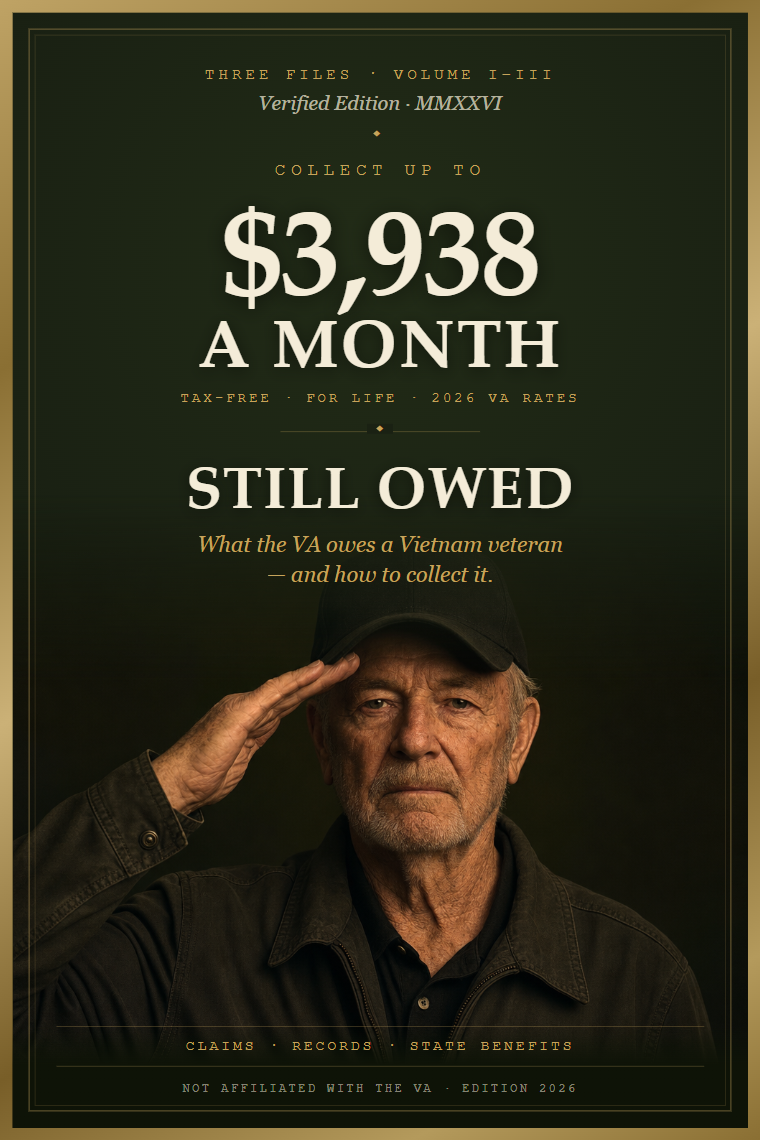
For decades, a Vietnam veteran had to PROVE that the diabetes, the heart disease, or the Parkinson’s came from something sprayed over him in 1969. That took a medical expert and money. Almost nobody could do it — and that is why the letter said no.
Congress deleted that requirement. For nineteen conditions, if you served in a qualifying place, the connection is now presumed. You don’t have to prove it. You have to show up with a diagnosis and a location.
A denial from 1979 tells you nothing about what happens if you file today.
Nineteen conditions. Eight qualifying locations. One rating that pays as much as $47,262 a year — tax-free, for the rest of your life.
This is a map, not a claims service. We file nothing for you, we take no percentage of anything, and the help you need is free. Page one tells you where to get it.

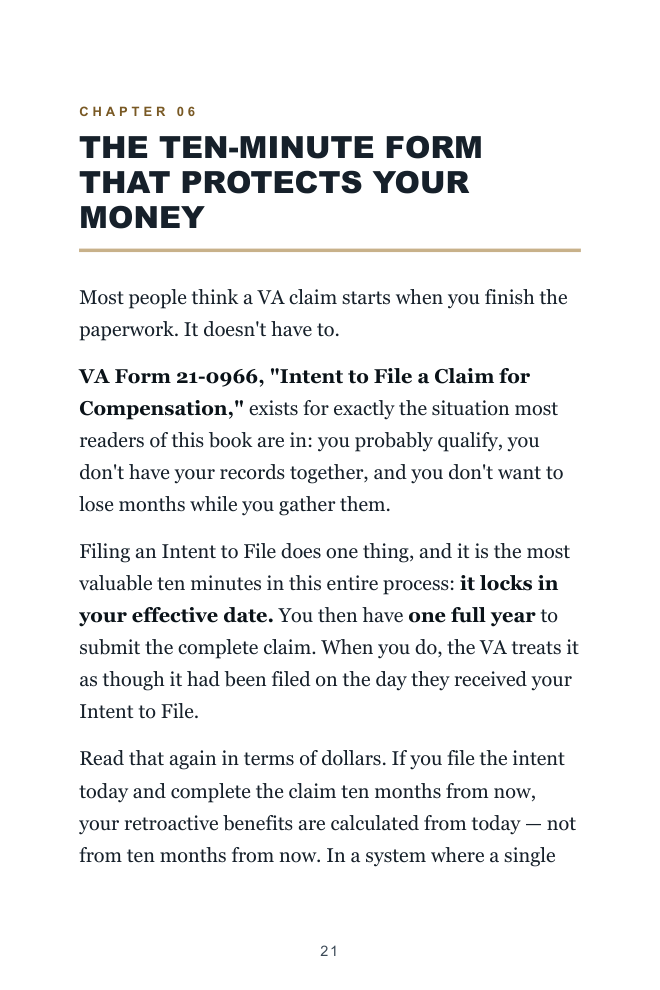
The VA pays you back to the day it receives your claim. Not the day you got sick. Not the day you were exposed. The day the paperwork lands.
There is a one-page government form — VA Form 21-0966, “Intent to File” — that plants that date and gives you a full year to put the real claim together. It is free, it is public, and it is on VA.gov. You do not need a diagnosis, a lawyer, or a single page of evidence to file it. We earn nothing from it.
Most Vietnam veterans have never heard of it. That is the whole problem with this system: the thing that protects your money is free, and nobody tells you it exists.
At a 70% rating, every month without a date on file is $1,808.45.That money is not late. It’s gone. No appeal recovers it, because there’s nothing to appeal — the VA simply pays from the date it has, and a later date is a smaller cheque.
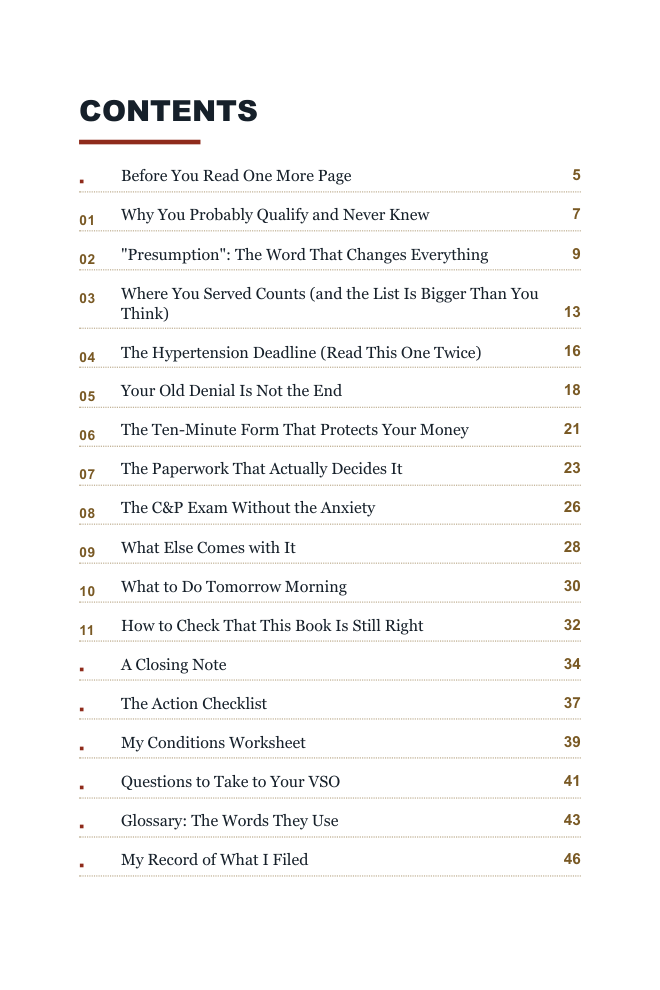
Chapter 6 of FILE ONE walks through that form line by line — what to put in each field, what happens after you send it, and the mistake that voids it. Chapter 10 shows you how to find the accredited representative in your county who will fill it out with you, at no cost.
Almost every VA claim asks for three things: a current diagnosis, something that happened in service, and — the hard one — proof the two are connected.
That third piece is called the nexus, and it’s where claims go to die. It normally requires a doctor willing to put his name to an opinion about a jungle he has never seen and a chemical he has never handled. That costs money you weren’t going to spend in 1979.
A presumptive condition removes that requirement completely. Not “makes it easier.” Removes it. Serve in a qualifying place during a qualifying window, hold one of the listed diagnoses, and the VA presumes the connection. There is nothing left to prove.
Here is the part that stops people cold.
Read that list slowly. Then read it again thinking about your last three doctor visits.
Type 2 diabetes is on it. Ischemic heart disease is on it. High blood pressure is on it. These are not exotic diseases — they’re the most common diagnoses in American men in their seventies, and for a Vietnam veteran several of them arrive with the hardest question already answered in his favor.
And the map got bigger too. Boots on the ground in Vietnam was the old rule. Thailand, Laos, Guam, American Samoa, Johnston Atoll, the inland waterways, ocean waters within twelve nautical miles — all of it counts now, inside specific date windows. Men who never set foot in country are covered.
If you have one of those conditions and you served in one of those places, you are not “probably not eligible.” You are the exact person the law was rewritten for.
These are the published 2026 rates. Not estimates, not projections, not ours. They are not taxed, and they continue for the rest of your life.
2026 VA compensation rates · verify at VA.gov · not taxed · paid for life
The VA pays from the date it receives your claim. Every month above is not a payment that arrives later. It’s a payment that never happens.
Every veteran service officer in this country has heard that sentence. Most of them hear it weekly. It is the single most common reason a Vietnam veteran never filed — more common than not knowing, more common than the paperwork, more common than the denial.
It is the most admirable thing about your generation, and it has cost that generation more money than every denial letter ever mailed.
So let’s be plain about the arithmetic of it.
There is no pool. There is no fixed pot that empties when you take from it. Nothing you are paid is subtracted from a man who was hit worse than you. Congress appropriated this money for a population defined by where they served and what they are now sick with. You are inside that definition or you are not. Declining it does not move a dollar toward anyone.
The men who had it worse are not competing with you. Many of them are dead, and a great many of the living ones already filed — because someone finally told them the same thing someone is telling you now.
You are not asking for charity. You are collecting on a thing that was already decided, by a law with your service written into it. The paperwork is the only step left.
And if it still sits wrong with you, consider filing for the person who will handle your affairs. A service-connected rating changes what your spouse is entitled to after you are gone. That part is not about you at all.
You already know that. He has had forty years to file and he hasn’t, and it isn’t because he’s confused about the forms.
So here is what’s actually in front of you.
Your father has a folder somewhere. You probably don’t know where it is. Inside it, if you’re lucky, is a DD-214 — the discharge document that proves everything. If it isn’t in that folder, you’ll find out at the worst possible moment: a funeral director will ask you for it, and the VA will not pay for a headstone, a burial allowance, or a flag without it.
There’s a second problem behind the first. In 1973 a fire at the National Personnel Records Center in St. Louis destroyed millions of service files. If his is among them, the reconstruction has a specific process, and almost nobody outside the VSO world knows it. FILE TWO is that process, in order, in plain language.
What you can do this month, in roughly two hours:
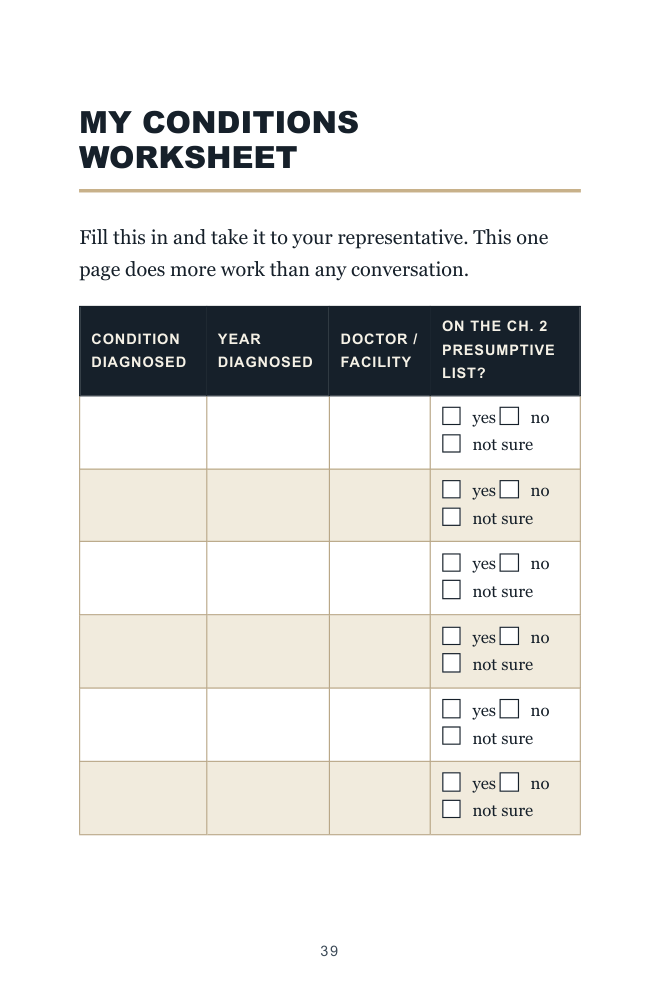
The worksheets are built for this — large print, wide fields, designed to be filled in at a kitchen table across from him. And they’ll do something the conversation alone will not: they turn “let me help you, Dad” into “help me fill out this page,” which is a request he knows how to accept.
You should know how the other side of this works.
There are unaccredited, for-profit companies — veterans call them claim sharks — that charge a fee, often a share of your retroactive award, to do work an accredited VSO does for free. Congress repealed the criminal penalties for this in 2006. The VA’s remaining tool is a cease-and-desist letter, which has been about as effective as it sounds. A bill to restore those penalties, the GUARD VA Benefits Act, has been introduced but is not law.
Which means today, right now, it is perfectly legal for a company to take a large piece of money you are owed, for filling out a form the VFW would have completed at no charge.
Put a number on it. One year of back pay at 70% is $21,701. A company taking a percentage of that walks away with thousands of dollars — for paperwork the VFW would have done for nothing.
We are not that, and we are not competing with it. We don’t file anything. We never see your claim. We could not take a percentage if we wanted to.
We sell the map for $37, once.
And since a cheap price on a book about money makes people suspicious, here is the honest reason it’s $37 and not $297: it’s a file, not a service. There’s no printing, no warehouse, no shipping, no staff answering claims. The only real cost was the research and the fact-checking, and that cost is the same whether four hundred veterans read it or forty thousand. We would rather it were forty thousand.
That’s the entire business — and it’s why the first thing on this page told you to go do something free.
This audience checks things, and refutes them in public. So every dollar figure, date, form number and web address in all three files was verified in July 2026 — and each one is printed with its source and the date it was checked.
Chapter 11 of FILE ONE does something most books won’t: it teaches you to verify all of it yourself, at the source, and to spot the moment this book goes out of date. That chapter will outlast everything else in here, and it’s the reason you can trust the rest.
| Claim | Source | Checked |
|---|---|---|
| 100% rating, no dependents — $3,938.58/mo | VA 2026 compensation rate tables | ✓ Jul 2026 |
| Hypertension added as an Agent Orange presumptive | PACT Act · 38 CFR § 3.309(e) | ✓ Jul 2026 |
| Thailand base service qualifies, 1962–1976 | VA Agent Orange exposure locations | ✓ Jul 2026 |
| Effective date runs from receipt of claim or Intent to File | VA Form 21-0966 · 38 CFR § 3.155 | ✓ Jul 2026 |
| Accredited VSO representation is free | VA Office of General Counsel | ✓ Jul 2026 |
Three readers, three different situations, three different states. Each one moved a real claim with a specific chapter.
Denied in 1979. I put the letter in a drawer and that was the end of it for forty-four years. My daughter found this and made me read Chapter 3 — Thailand counts now, and I was at Udorn in ’72. The type 2 diabetes was already on the list. My county VSO filed in April and it came back at 70%. I have not opened that drawer since.
I bought this for my father and he would not open it. So I opened it and started filling in the conditions worksheet myself and asking him the questions, which is the only way he was ever going to go along with it. File Three didn’t do much for us — Iowa’s exemptions are thinner than I hoped — but File Two was worth the whole price. We could not find his DD-214 anywhere and I had no idea the records center burned in 1973. About three hours across two evenings.
I assumed this was another outfit trying to take a cut of my back pay. What changed my mind was the first page telling me there was a free government form that protects my back pay, before I had paid them a dime. Nobody selling something tells you the free part first. The VFW did the rest at no charge, exactly like it said they would.
Seven days. If it isn’t what you needed, write to us and the $37 comes back the same day — and keep the files. We’re not going to argue with a Vietnam veteran about a refund.
Delivered instantly · printed set available · no subscription, nothing recurring, no upsell after this page
One month at 70% is $1,808.45. The whole set costs about two percent of a single payment — and you only pay it once.
That’s the reason these books exist. You were almost certainly denied on the nexus — the requirement to prove the connection — and for nineteen conditions that requirement no longer exists. A denial issued under a rule that has been repealed predicts nothing. FILE ONE walks through reopening an old claim step by step.
No, and this is the most overlooked change of all. Thailand, Laos, Cambodia, Guam, American Samoa, Johnston Atoll, the inland waterways and ocean waters within twelve nautical miles all qualify inside specific date ranges. Men who flew, sailed, or guarded a perimeter are covered.
VA disability compensation isn’t taxed and isn’t counted as income for Social Security retirement. FILE ONE covers how it interacts with SSDI, military retired pay and state benefits, because that’s where the real confusion lives.
There’s no age limit and no filing deadline. What there is, is an effective date — the VA pays back to the day it receives your claim, so the sooner a date is on file the larger the retroactive payment. Chapter 6 covers the free one-page form that sets that date, and Chapter 4 covers the one dated change coming on October 1, 2026.
Yes. Accredited VSOs will prepare and file your claim at no cost, and we tell you exactly how to find one. What we sell is knowing what to ask for before you walk in — which conditions to raise, which locations to name, what your old denial actually said, and what your state adds once the rating exists. You can absolutely do this without us. Most men haven’t, for forty years.
Start with the conditions worksheet in FILE ONE. Don’t open with “let me help you” — open with “help me fill out this page.” Section V above lays out the whole approach, and the worksheets were designed for exactly that conversation.
Large print throughout, high contrast, wide margins, and every worksheet is built to be photocopied and filled in with a pen. It was designed from the start for a 78-year-old at a kitchen table in the morning, not for a phone screen.
Seven days, full refund, and keep the files.
It did not expire. Nobody withdrew it. The only thing that changed is the rule that stopped it — and that rule is gone.
$79
$37 for all three files. Seven days to
change your mind, and you keep them either way.
Whatever you decide about this book: the help itself is free, the forms are public, and no one should ever take a percentage of your back pay. That was true before you found this page and it will be true after you leave it.